
Driven by Hyundai Motors, exports of passenger cars from India jumped 28 per cent to 1,60,677 units in the financial year ended March 31, 2005.\n
Accelerated by top three automakers -- Maruti, Hyundai and Tata Motors -- the car sales posted a phenomenal 73.1 per cent rise in February, promising an impressive performance during 2003-04.
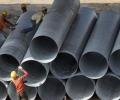
Industrial metals (ferrous and non-ferrous) suffered great volatility once the Ukraine War began in February 2022. First, there was a sharp price rise due to fears of supply disruption, followed by weak global demand. China's weakness and rolling lockdowns have hit production and demand.
Domestic passenger car sales grew by 23 per cent in December 2006 at 81,026 units as against 65,853 units in the same month a year ago.
Passenger car sales saw a modest single digit growth in the domestic market in January 2005 at 8.17 per cent even as motorcycles continued their strong run, witnessing a 22.8 per cent jump fuelled by higher demand for Hero Honda and Bajaj Auto bikes.
Car sales surged by a robust 18.1 per cent in August 2004, for the fifth consecutive month this year as a spate of new models and easy availability of loans with low interest rates drove the industry northward.
The optimism stems from benign fuel prices, adequate and well distributed rainfall and the recent measures announced by the government to boost liquidity at banks and NBFCs.
Car sales went up by an 18 per cent in July 2004 for the fourth consecutive month this fiscal buoyed by Maruti, Hyundai and Tata Motors.
Driven by the top three carmakers -- Maruti, Hyundai and Tata Motors -- the car sales surged by 25 per cent in June 2004 over the same month last year.

Honda will launch 4 cars in India soon.
Car sales surged by a robust 32.4 per cent in the first month of this fiscal with Maruti and Tata Motors fuelling the growth.
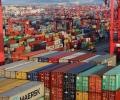
Indian exporters are keeping their fingers crossed on account of rising Covid infections in China and other countries as it could again disrupt supply chains and affect demand for goods. Federation of Indian Export Organisations (FIEO) director general Ajay Sahai said that if the cases continue to increase in the coming days, it may have implications on imports. "We are keeping our fingers crossed," he said.
Exports of Made in India vehicles went up by a whopping 56 per cent during the last fiscal as cars, commercial vehicles and two-wheelers continued to charm overseas buyers.
The increase in bus and truck sales of Tata Motors and Ashok Leyland pushed commercial vehicle sales up by a robust 35.7 per cent in the first eleven months of this fiscal.
Automakers have asked the government to halve the excise duty on cars and utility vehicles to 16 per cent to spur demand.\n\n\n\n\n\n\n\n
The domestic car sales rose by 36.5 per cent in December as nine out of 11 carmakers recorded more demand due to lower prices after a budgetary cut in excise, cheap finance schemes and announcements of price hike in January.
Nepal's decision to ban the import of non-essential items amid depleting forex reserves may hit Indian exports. The country's central bank - Nepal Rastra Bank - last week instructed commercial banks not to open letters of credit (LCs) for importing non-essential items. This is to prevent further decline of the country's foreign exchange reserves. However, it has not issued any formal communication yet.
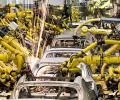
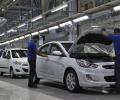
Indian automobile units are employing more and more robots to improve your car's efficiency. India is catching up well as world over, the latest technologies is redefining outdated manufacturing processes.
Surging truck sales of Tata Motors, Ashok Leyland and Eicher Motors drove commercial sales up by 34.6 per cent during the first eight months of this fiscal.

The move will make it the first global automobile major to design a vehicle here
Cheered by Maruti, Hyundai and Tata Motors, car sales surged by a robust 24 per cent in October 2003 as customers got attracted to low interest finance and a spate of car roll-outs.
Billionaire Mukesh Ambani's Reliance Jio is India's strongest telecom brand in India, ahead of Bharti Airtel and Vodafone Idea Ltd, according to brand intelligence and data insights company TRA. TRA, formerly Trust Research Advisory, in its 'India's Most Desired Brands 2022' ranked companies according to their brand strength. Reliance Jio topped the telecom category, followed by Bharti Airtel, Vodafone Idea Ltd and BSNL.
Propelled by Maruti, Hyundai and Tata Motors, car sales surged by 12.8 per cent in September 2003 as customers reaped benefits of low interest loans and budgetary cut in excise.
The domestic car sales rose by a modest 6.7 per cent in August 2003 as market leader Maruti, Fiat and Hindustan Motors suffered a decline even as Hyundai and Tata Motors improved their performance.
Passenger car sales rose 9.7 per cent in the domestic market in September to 77,411 units against 70,507 units in the same month last year.
Car sales zoomed nearly 38 per cent to 59,800 units in July when compared with 43,434 units sold in July 2002, according to data released by the Society of Indian Automobile Manufacturers on Thursday.\n\n
Car sales in the country surged by 41 per cent in May 2003 as all major companies like Maruti, Hyundai and Tata Engineering recorded strong growth following an eight per cent excise duty cut in this year's Budget.
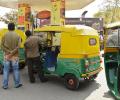
Amid a shift in mobility trends and people increasingly opting for less polluting energy sources, sales of compressed natural gas (CNG) vehicles increased more than 82 per cent in the past five years. A total of 729,902 CNG vehicles were sold in 2022-23 against 400,825 in 2017-18, according to VAHAN Dashboard. Though the increase in sales of CNG-powered vehicles has been significant, their share in overall vehicle sales remains minuscule as is the case with EVs.
Domestic passenger car sales jumped 28 per cent in April to 42,506 units from 33,195 units in the same month last year, the Society of Indian Automobile Manufacturers said on Wednesday.\n\n\n\n

As part of the new Central Motor Vehicle Rules, the government is framing a mandatory recall policy entailing penalties.
India's domestic passenger car sales rose 7.64 per cent in November, slowing after three months of double-digit growth as buyers postponed year-end purchases to the next year to boost resale values.
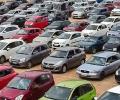
The economy segment of India's car market is unlikely to revive soon term as inflation and prices prompt buyers to defer purchases. The share of entry-level cars in the passenger vehicle market dropped to the lowest in seven years at the end of the Financial Year 2021-22 (FY22). A recovery in the segment will be largely driven by the overall economic growth, improvement in income levels, and easing of semiconductor shortage, say carmakers and analysts.

The first leg of the 35-day festive period, which ended with Dussehra, failed to bring any cheer for auto companies. While makers of passenger vehicles struggled to meet demand due to the persistent shortage of semiconductors, a recovery in demand remained elusive for two-wheeler manufacturers despite offers and schemes. The overall season, which ends two days after Diwali, is unlikely to bring any turnaround in either the supply or the demand scenario, said dealers and officials at auto companies.

The $100-billion SAIC would have a dedicated manufacturing facility in India, and would be the first Chinese automaker to do so.
Car sales surged by 31.2 per cent in October 2004 for the seventh consecutive month this fiscal spurred by low interest rates and launch of a spate of new models.
